Wednesday, January 11, 2017

Dolores hairstyling for men


Dolores

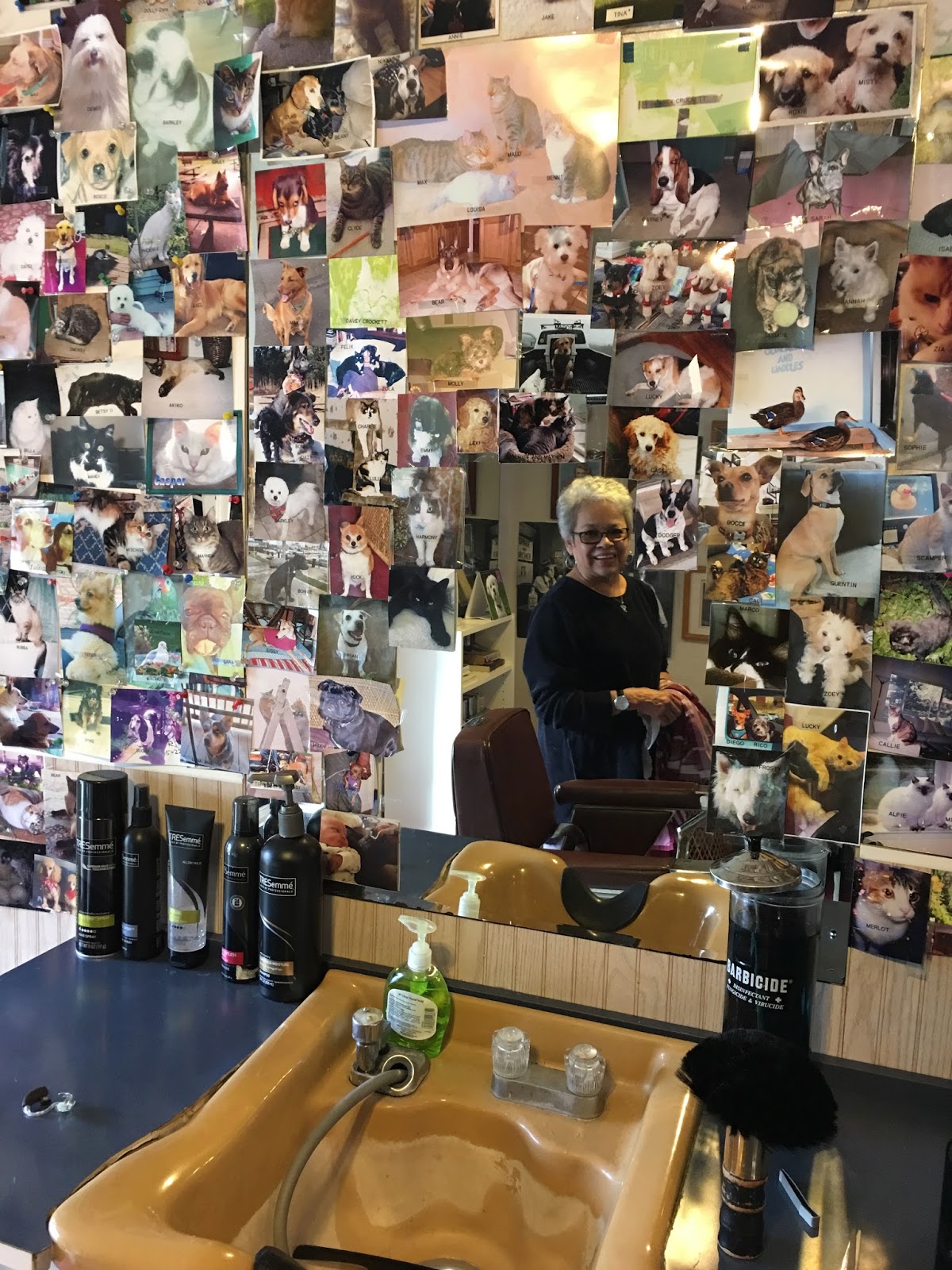
   It's an enclave for high and pop culture, where guys can view oil paintings in the abstract expressionist mode, à la Jackson Pollock, and savor posters from old Humphrey Bogart movies. It's also a refuge for animal lovers. My haircut can by interrupted while she gives a biscuit to a dog who stopped by the salon to say hello. Then when Dolores finishes, and wheels me around to confront the mirror, my visage is framed by a wall covered with photos of her customers' pets. Felix and Zola are up there, snuggling with Jean.

    Dolores herself lives with Merlot, a fussy beast, whom she accommodates with the judicious use of cat treats. She's also an avid reader and likes jigsaw puzzles, and her books and partially completed puzzles add to the ambiance.


Still life with pet wall and mirror
Pet wall detail:
Beautiful woman with her two justly famous cats


    She can tell you the exact number of days since her husband passed of a heart attack in 2012. He had been ailing, but his death still came as a shock. She admits to getting angry at him for abandoning her, although she has girlfriends she goes out to lunch with regularly. Another romance someday? Possibly not.

What's a hair cutting salon
 without a little abstract
expressionism?
Bogart Tribute Wall
    But she was understanding last July when I told her a hike with a love interest had motivated me to come in. That, and it had also been five months since my last visit, and my unruly locks had started to look unprofessional, even by the lax standards for college lecturers. She assured me I'd soon cut a dashing figure on the trail, and set to work.  She trimmed the eyebrows and the ear hairs too, those flags of aging, and when she asked me to inspect her handiwork I cried "Magnifico!" and we laughed. There I was, the best looking me possible — mean anything? And there we were, both surviving spouses, both doing our best.


The view from across the lobby
     My coiffure once again looks quite unprofessional. No surprise, the season has changed twice since my last haircut. The Bay Area autumn was not as dramatic as Michigan's, but the leaves did turn color; I crunched through piles of them on the sidewalks. The brisk cold winter makes my bald spot tingle, makes me glad to have some place to go called home.

     That home is on a small island off the coast of Oakland. It has an attractive old art deco building at 1415 Broadway, only three blocks from Park and Central, the throbbing heart of Alameda café society. Going there is a different experience than going to a strip mall.  Salon Dolores, on the ground floor of the vaulted lobby, feels different than the Supercuts experience. One more dose of her care and acceptance, and I'll be truly ready to face 2017.


1415 Broadway in Alameda, salon on left of the entrance

Wednesday, January 4, 2017

These two old guys decide to celebrate New Years Day by riding up a mountain …


Oded and Matt, claiming their bragging rights
New Years Day, 2017
       So, Oded and Matt get decked out in cyclist regalia, helmets, sunglasses, the works, and the punch line is … Oded's helmet saved him from a serious head injury!  Seriously, if you a ride a bike but eschew helmets, please reconsider.
Oded's helmet, after the fall

        Misfortune struck on the descent. Oded's rear wheel suddenly went out of true, and threw him off his bike. He hit the pavement on his head and shoulder, smashing the right side of his helmet, and tearing his jersey. His clavicle ached, and the rear wheel would not turn freely. But a couple in a pickup truck saved the day when they stopped, and without hesitation offered  to drive Oded down to the Walnut Creek BART station — offer accepted, and thank you so much! Later, the ER found that his clavicle was intact, and that the helmet had performed its function well and protected the most vital organ of all from injury.

Oded, while Matt was still climbing
     Second punch line: I made it the summit too!  Very pleased with myself, although I arrived 21 minutes after Oded, five years my senior, and still employed at BofA after me and many other of his work buddies were pink slipped in 2014.  He would have got to the top sooner, except that up to the juncture (2,200 feet) he would stop and wait for me to catch up.

Rest stop at about 1K feet,  South Gate Road
At least it was an improvement over my performance on New Years Day 2015, when the juncture was as far as I got.  (As an aside, modest Oded credits his cycling superiority only to his continued employment at BofA's nearby Concord Tech Center,  allowing him to practice mountain climbing after work.  In my opinion, it's because he's a force of nature.)


Moosie with Alison, 2015


    Historical note.  Alison, who appeared in the 2015 Diablo ride blog entry, was at it again this year, still sporting pink panniers and a stuffed moose as a rear rack ornament. But we only had the chance to say "hey" as she zipped by quickly on her way down from the summit, as I was making my slow ascent.


Tuesday, November 15, 2016

Misadventures on the Day After: Confessions of a Brat

Wednesday, November 9, 2016

9:30 am
    "It's a national day of mourning," Dr. L. tells me, by way of explaining my 15 minutes wait in his exam room.

    "You're asking what brought me in today," I guess.

    He shakes his head, leans in close, says, "we'll get to that," and then repeats what he said about the big news.

    He's an African-American about half my 66 years, and on a rogue impulse I put a hand on his shoulder and say "I'm sorry."  And then almost compound the weirdness by trying to explain myself, by saying something like Trump will be more of a disaster for some Northern Californians than for the white guys.

    He shakes his head again.  "He didn't need a get-out-the-vote campaign," he says, "all his small-town voters were self-motivated."

    Down to business.  What brings me in is sudden hearing loss, on top of the moderate/severe loss that became my new normal a decade ago.  For a couple of weeks now, it's been a struggle to talk to just one person in a quiet room.  Case in point, our conversation now.  I'm a teacher, and worry about keeping my job if my students need to ask questions by writing them down. 

    Dr. L. looks inside, says the problem is only fluid buildup behind the right eardrum.  He wants to schedule a hearing test before draining it, to measure the effect.  I ask him to do it now, so this very afternoon I can hear my students.  He agrees to rearrange his schedule to fit me in.

10:00 am
    Dr. L. stands behind me, numbs my right ear, and inserts a hypodermic needle.  I hear muted slurping sounds, and when they stop, other sounds in the room not noticed before.  Thank you doctor!

10:30 am
    Hillary makes her final campaign appearance while I drive to Rockridge BART. To fill air time before she starts, NPR pundits savor the memories of concession speeches of yore.  Al Gore in 2000, now there was an example of accepting defeat after winning the popular vote!  Kerry 2004, a good one too. The right words now, from the gracious loser, and America would return to its comfort zone; just as if we had not witnessed our complacencies crumbling beneath us all year.

    To me, the most memorable part of Hillary's speech is the very end, where she says her campaign will live on to inspire future generations of girls, who know now that there are no limits to their aspirations.  Embracing a cause larger than herself, or seeing herself as the great cause in which others can find themselves?  Can't decide.  She doesn't grieve for the girls who will suffer if Trump cancels their parents' health insurance; if the thought occurred, during the long night, that her campaign may live on as an example of smug ambition opening the door for disaster, it doesn't leak through to her public persona.

    But the pundits do seem soothed.  They praise Hillary for pledging to support the President-elect, as well as for conditioning that support on respect for the principles of equal protection under the law, and freedom of religion.  Not to worry — if Trump's white nationalists start bothering the likes of Dr. L., they'd cross Hillary's fearsome line in the sand.

11:00 am
    I park, get out of the car, but suddenly my legs feel rubbery, I'm dizzy and nauseous.  Someone's leaf-covered yard looks inviting, and I kneel down by the sidewalk, arms on the ground in front of me, head in hands. Don't remember ever feeling so sick.  Just want to rest, feel the cool ground under me.  But there are two phone calls to make.

    The Computer Science chair at CCSF doesn't pick up; my voice mail says my 3 pm class looks dubious.  The receptionist at Dr. L.'s office says she'll get him while I wait.  On-hold music is streaming through my hearing aids when two motorcyclists stop and walk toward me, wearing concerned expressions.  Want them to stay, don't want to impose, not thirsty, but ask for water anyway.  They give me a bottle of Evian. Say thanks, wave them away.

    Dr. L. comes on the line and says that I'm experiencing an ear drainage side-effect.  He offers to call in an anti-nausea prescription to a nearby pharmacy. But where would that be, and how would I get there when I don't want to move?  He says that in any case, the symptoms only last 2-4 hours.  That's great news anyway, thank you doctor, bye for now.

    A woman walking a big dog asks if I need anything, keeping a wary distance. I ask to use her bathroom, though it's not urgent.  She says something I can't get, but guess it's that she never opens her door to strangers.  Tell her I understand.  Someone crouches low on the sidewalk next to me.  It's an effort, but I turn my head and see a woman even younger than Dr. L., with shortish hair.  She tells me her name is C.  She asks what happened.

    Tell her about the ear stuff. Where I was heading now?  Tell her about CCSF.  C. says she's a college instructor too, at a community college and a state university, like me.  But she teaches criminal law, she's an attorney who knows the criminal justice system from the "inside."  Arrested protesting at Livermore?  "Good guess," she says.  They picked her up when the police decided to arrest the attorney witnesses at a prisoner rights protest.

    Where was she last night when she heard the news?  At a party, where people pay to destroy things — the priciest item on the menu was the chance to whack a car with a sledge hammer.  Where was I?  At the gym, doing 20 miles on an exercycle, watching the tallies mount on CNN, hoping, hoping.

    Was there someone she could call for me?  The truth comes out — I live alone.  Strictly speaking that's not true, but Clark couldn't drive over, or even take the bus, on account of he's a cat.  Did I want her to summon an ambulance?  Say OK, and she makes the call. Someone else joins us while we're waiting. Turn my head again, and it's another young woman, with a South Asian complexion and a slender gold nose band.  She introduces herself as N.

11:30 am
    When the ambulance comes I refuse to let them take me.  Too much work, by the time they admitted me, I'd be ready to be discharged.  The head EMT says it's against their regulation to leave someone lying on the street.  I say "Screw the regulations."  He consults with C. and N., then tells me to sign a release.  I make it to my knees and make an X on a touch pad.  The ambulance leaves without me.

    Remarkably, C. and N. don't leave as well.  Wouldn't you be tempted to say "screw you too," if you went out of your way to provide someone the help he asked for, and then he spurned it?  Instead, C. offers to get the anti-nausea prescription for me.  Say OK again, and she calls Dr. L.  Her voice is soothing although I can't make out her words, and when she's done I give her my health insurance card and a working credit card, and she heads off.  N. stays.

    Self-pity attack.  Tell N. "I'm an old man, sick on the street, and Trump is President!"

    "There is that," she says wistfully, referring to the last item on my list of woes.  I start crying, really I do.  N. asks if she can bring me anything, and I say no, just her offering is enough.

12:00 pm
    C. returns carrying a little white paper bag, and N. leaves.  C.  says we'll need to go to her house, only half a block from here.  She helps me to my feet, I put my arm around her shoulder, and off we go.  Just 5 more house, 3, 1, now up these few steps.  She helps me through the front door, and tells me this is where she lives with N. I understand them as a couple.  She hands me the little white bag and points me toward their bathroom.

    I sit on the toilet for a spell, then take a brief nap, poised on the edge of the tub, head resting on the sink.  When I emerge, N. points me toward an easy chair, covered with a sheet, and provisioned with a large metal bowl. I flop down and open the bag.  Of course the medication is a rectal suppository, what else could you give someone who can't hold anything down?  I say "Oh,"  close the bag again, close my eyes.  If C. was miffed that once again I'd spurned the help I'd asked for, she doesn't say so.  Zzzzz.

2:30 pm
   C. wakes me up and says she'll need to leave in half an hour.  I plead for a little more time, and she agrees to 15 more minutes.

2:45 pm
    C. wakes me up again, and I gather my things and stand without help, stomach quiet.  I get her address for a thank-you card.  She sees me to the door.  "Check this out" I say, and descend the steps, arms raised in triumph high above the handrails.

Sunday, September 18, 2016

Two Rivers


    Most people have their quaint little rituals when they go to cemeteries and remember.  Mine is to bring Jean roses, and speak the news as if she could still hear.  She would have been pleased with most of it, but irked by the story of her headstone.  Oakmont installed one in the winter of 2014, one year after, and I immediately started trying to get it replaced.  Imagining her impatience, I would appeal to tradition.  Jean was a procrastinator too, and most often in her case the wait was worth it.

    The wait for the new headstone ended just before this Labor Day, thanks to the valiant efforts of the sculptor and artist John Gregorin.  John turned my vague concepts into a design, which he then adapted to meet the requirements of the engravers.  The ink well in the middle with two quills was John's idea, as were the dancing roses on my side: writing stuff together was one of our favorite parts of being married; and we met folk dancing.  Two Rivers, the song whose first bars are on the bronze, was the first waltz at our wedding, and John and his sweetie Sue Torngren played it at Jean's memorial.  Both have been invaluable, loyal friends.

    Jean might actually have approved of the first headstone for its simplicity, only our names and the three dates we know, had it not given her name as "Jean M. Lewis."  She was never that except on the letterheads of business correspondence.  She's "Jean Mary Lewis" on the new one, as she was on her diplomas, or in marital moments of high ceremony.  One night, early in our marriage, I lay awake thinking about those three words, and discovered they were an anagram for "My real sin, a Jew."  She laughed in the morning when I told her, saying I just didn't rate in the major transgression dept.

    How did the wrong name got there in the first place?  The short, best answer is that's the sort of thing that happens when unopened correspondence piles up one's desk. Oakmont did tell me there was still time to make changes, when I finally did get around to opening their letters.  But then they installed the headstone anyway, and I only found out about it when visiting Jean.  At a tense meeting afterwards, they exhibited a contract I'd signed agreeing to a default design — they'd told me at the time of wild grief that they just wanted to have something on the record.  Some heated exchanges followed, but in the end they agreed to waive most of the fees on a marble extension and changes to the bronze.  Thanks Oakmont.

    John, Sue, the blessings of conflict abatement, my news had a theme on my first visit to Oakmont after Labor Day.  One reason for insisting on the new headstone was to find another way to say thanks for the marriage. And I told her how grateful I was for the change in my younger son Sam, who just earned his one-year clean and sober badge — a huge difference from the addict she knew when she was sick.

    There was some sad news too: Laurie, an old friend from their student days at U. of. M., had succumbed to leukemia.  Laurie was in remission in November 2012 when she took a week off from being a prof at the University of New Mexico to come to California to help care for Jean.  She was one of a long list of friends and family who were wonderful to us during that terrible time: John and Sue of course, but also Yao, Amy and Ellen, other friends from college days who came out to help; Karen, who visited almost every night at the hospice; Craig, who sent us the world's best creative cheer-up cards; Derek & Tara — Derek was the who used the line "Life thrived at her touch" at Jean's memorial, and Tara's memories are a separate blog post.  Bob and Terry, Anne and John, Chuck and Kathy, Ray, Shadie, … too many to even try to list.  If you're in the right frame of mind, even the death of friends leads make to feelings of gratitude.  Life is sweet.


The neighborhood at Oakmont

Saturday, September 10, 2016

A Knight to Remember


Mickey Pico memorial inset
    It took a while, and a few tense negotiating sessions, but this summer Oakmont augmented their generic bronze headstone with a marble extension that provides a fitting memorial for Mickey Pico.  As you can see from the photo, the memorial now uses "Mickey," the name we all knew him by, mentions three of his sterling qualities, and features an inset picturing Mickey Bagel Bistro, the pride and joy of his career.

    The family offered many suggestions about verbiage, including "Crazy Generous'" and "Sold the Best Bagels in Juneau."  But there's little room on a headstone to develop a theme.  Even a haiku would be wordy, and a bit absurd, as if you're trying to argue with death.  To me, the ostentatious tombs are some of the saddest places in Oakmont.


Mickey Pico memorial, with inset on upper right.
The headstone is easy to read when you're
actually there, despite the oak tree shadows.
    It was a hard decision.  "Warmly Generous Caregiver" made the cut, to acknowledge his care for our mom, Esther G. Pico, during the last difficult years of her life.  And the way he could not pass by pandhandlers without giving them something, always something that rustled, never something that clinked.

    "Merchant" is on there, because "Entrepreneur" and "Street Merchant" didn't quite do it — in this case, less really is more.

    And last but not least, "Loved the Open Road," because he did, all his life.  From the he was a boy traveling with our dad, Charlie Pico, across the U.S. and Canada in his annual circuit of rodeos and fairs; to his adult life, traveling around like a knight errant, committed to living his ideals the way some people are devoted to paying off their mortgage.

   Mickey Pico, big-hearted paladin, lover of the physical world, R.I.P.
   

Sunday, August 21, 2016

Saturday Morning at the Movies: Political Reality and its Discontents

Inforgraphic from
Fix-It: Healthcare at the Tipping Point
 
   There is an eminently practical solution to a terrible problem that is not an issue in this election campaign, simply because it's considered to be political impossible.  Saturday morning, about fifty dreamers who want to make it an issue, gathered at the Rialto Theater in El Cerrito to watch the movie Fix It: Health Care at the Tipping Point.

The Rialto Theater in El Cerrito,
supported by the generosity of many donors
    Our health care sysem is a slow-motion train wreck.  The U.S. spends 17% of it's GNP on health care, and even with the ACA, that figure has been on the rise — and 1/3 of all health care premiums are eaten up in administrative costs.  Most bankruptcies in the U.S. are due to medical expenses; many of those bankrupt had insurance, but it didn't cover enough.  Health care costs are only around 10% of GNP for the EU, where health care insurance is not tied to employment. They also have a higher life expectancy,

    Single-payer is a practical solution to the health care mess because when a single entity buys insurance for everybody, costs are lower and health outcomes improve.

    And alas, single payer is politically impossible when we're only hanging on to the Affordable Care Act by the skin of our teeth.  The Republican congress voted to repeal the Affordable Care Act (ACA), but last February the House failed to override President Obama's veto.  Hillary says she wants to extend the ACA by offering a "public option," which would compete with private insurance plans.  But unless there's a dramatic change of fortunes in congress, she would need to play defense too.  Donald J. Trump says he would ask congress to repeal the ACA on the very first day of his administration.

    Fix It emphasizes that single-payer saves both lives and money.  The movie was funded by Richard Master, owner of MCS Industries, which makes picture frames and decorative mirrors. The company was struggling to meet annual increases in health care insurance, and Richard decided to try and find out why. He discovered the system was broken, and that in the words of the movie's title, there's a fix.  The movie also features a Republican legislator from Pennsylvania, explaining that single-payer would be good for the economy because it would lower the cost of doing business.  Well, duh.  There's also an interview with a Canadian conservative, amazed that his fellow conservatives in the U.S. cannot grasp this logic.

    As for saving lives, many of us already know sad stories about people who could not afford treatment. One I'll never forget came courtesy of Jean's sister Anne, a retired radiation oncologist and a brain tumor survivor herself.

    Anne was invited to give a second opinion on a man who had been treated by another radiation oncologist for a nasopharyngeal tumor that had invaded his skull. Following that treatment, that doctor found necrosis spots in the man's brain and decided that the tumor had progressed even further. The man was told he had not long to live.

    However, when Anne examined the scans from the first treatment, she saw that his tumor was actually stable. The spots in his brain, all within the radiation fields of his treatment, were not evidence that the tumor had spread. Instead, they were areas of damage caused by the treatment itself, and the way it was given.

    Anne expected the man to be overjoyed when she called to tell him he would live. But she found that from the patient's point of view, her news had a serious drawback. Expected to die, his hospice care was paid for. Expected to live, he had to resume paying for his medications out of pocket. And how in the world could he afford to do that?

Monday, August 15, 2016

A smartphone commercial you would never see on TV

Gale Myra Pico with her new smartphone
August 9, 2016
    Walking on the sidewalk, sitting on a train, waiting for a table at a restaurant, most people so absorbed by their smartphones they don't look around and notice all the others doing the same thing they are, pecking away at small screens.  Does it make you feel disgruntled, like grousing that you've wandered into a remake of Invasion of the Body Snatchers, strange alien beings  inhabiting familiar forms?  Here's another side to the story.

    My sister Gale is a schizophrenic, and for the last 25 years she's been living
Gale, Sam, and Gabe, absorbed in their
phones, August 14 Patterson CA
in a group home in San Francisco, while coming to see me in the East Bay every month.  For the first 24 of those years, I'd arranged for her to come over by calling on her house phone.  Often nobody would answer and the voice mailbox would be full.  If someone did answer, and repeated shouts of "Gale, phone for you," elicited no response, there was no reliable way to leave her a message.  She'd conceived a firm dislike of cell phones, and had never browsed web.  In short, she lived with the technology that existed at the time she was first hospitalized, in the 1960s.


    Gale likes to read books in French, and her current favorite authors are Guy De Maupassant the Victor Hugo.  I would order books for, but my French is poor and once I made a mistake and ordered a Classics Illustrated version by mistake.  And the books would take a long time to arrive, were expensive, and Gale needed to keep a dictionary handy to look up new words.  Then last year, she suddenly agreed to accept an iPad so she could use an e-book reader.  Afterwards, the world of French literature was just a convenient click away, as were the definitions of words she didn't know.

    And then she learned how to use the Maps app to get around better on public transportation.  And then Pandora, to listen to Little Richard.  And then to use email — when one of hers showed up on my inbox, I'd think of how hard it had been to phone her before, and picture a small, isolated word expanding dramatically.


Gabe, Gale, ETa, and Sam, August 14 in Patterson
    But after a year, she started to feel a bit cramped in this brave new world.  It was still just as hard as ever to talk on the phone, and there were repeated problems with wi-fi at the group home, interfering with her music.  This summer she changed her mind about cellphones, and last week she got her first, an iPhone 6S+.

    She's already learned how to reply to texts using Messages, and to send new texts from Contacts, and to dial and answer the phone.  And she really appreciates being able to listen to her music on cellular data, when wi-fi isn't available.

    This Sunday Gale took her new phone with her to Patterson, near Modesto, when we visited
Eta and Gale, August 14 in Patterson
my younger son Sam. Sam has just earned his 11 month clean and sober badge — another world that's been expanding just recently.  The driver was my niece Eta, Gale's biological daughter, and my older son Gabe came with us too.  This was the first time Gabe and Sam had ever met Eta, who grew up in Israel — more expansions.


  The 3 youngsters had a good time, appreciating each other's coolness, while of course spending much time talking on the phone and texting.  But Gale was just as absorbed in her phone as they were in theirs, and everyone took time to help her.  It was all good to see, and I didn't grouse about alien beings once.