Tuesday, January 6, 2015

Fear and Aging on Mt. Diablo

The Grizzly Peak Cyclists
Gathering for the Diablo Ride at the
Pleasant Hill BART station,
9 am January 1, 2015
 They're not the whole truth, those confessions we make to ourselves about failure. But on the Grizzly Peak Cyclists annual New Years Day Mt. Diablo ride, mine were convincing. Pedals and wheels turned slowly, the bike wobbled, while my goal shrank to just making it a few more feet, to the next curve.  I scolded myself: you're 64; you've ridden only once since Labor Day; you're an imposition on your friend Oded, who's spending much of his ride time emailing on his cell phone while waiting for you to catch up.  Yet it was hard to feel chastened, immersed in the Diablo landscape, deep green thanks to the December rains. In a few weeks it will be a heartbreakingly beautiful vivid green, then fade to brown if the drought continues.  How lucky to be right here in this luminous moment!  Perhaps the prosecution overstates its case?
        Chronological age could not be the whole story. Oded turned seventy in November, and he still commutes by bicycle to the large financial institution where we toiled together for a quarter century.  Most weeks he rides his bike into the Berkeley Hills, and he went on the Diablo ride even though he's recovering from a bad cold.  It took us over four hours to reach the junction where the North and South Gate roads converge, elevation 2,170 ft.; just 58 minutes for him to continue solo to the summit, elevation 3,864 ft.  Alison, 65, was one of the dozens of cyclists who passed us on the way up, notable because her bicycle sported front and rear pink panniers, and a stuffed animal fastened to the rear luggage rack.  More about that lass in a bit.
        And if there's really no excuse for going months without riding, there is some interesting context. Over Christmas I had the stomach flu, and spent most of three days in bed, needing to sit and rest each time I hiked from the bedroom to the kitchen. It was a slightly altered state of consciousness: dozing; listening to excerpts of Hunter S. Thompson's Fear and Loathing in Las Vegas on NPR; calling the Aetna advice line.  The nurses were reassuring, prescribing rice and clear fluids, no dairy products; I was compliant.  The gonzo journalism was oddly reassuring too, showing that language could follow where mind leads, even unto the recesses of recreational drug use.  Nevertheless, there was no denying that I was sick, and living alone too, and fear introduced itself.
        At midnight, 3 days post-flu, 6.5 hours before I'd set my alarm to wake up for the Diablo ride, I was toasting 2015 with sparkling apple juice at a folk dance in Palo Alto.  It was a moment Jean would have savored.  In the cozy delirium of our marital myth, we had our own style of gonzo, say with carrot sticks dangling from our lips instead of cigarette holders à la Uncle Duke. A widower should not stay at home like a shut in on New Years Eve, especially after the lessons of recent illness.  The two dancers I talked to on the topic of New Years resolutions both agreed they were futile attempts to appease insatiable inner prosecutors.  You might have a careful, healthy existence, and still come to a horrible end because you bored yourself to death.  Better off trying to find a path to joy.
        It's not always joyful, obviously, but there is a sweet solitude in a long bike ride, when the rhythm of your exertions sets down a bassline as your eyes
Oded, South Gate Road
Elevation approx. 1,500 ft.
 explore the landscape and your thoughts roam over memories.  I thought about the slyly adventurous Jean, her "slackpacker" strategy when she hiked the Appalachian Trail as a college student: take every shortcut, but say you do it because it's the scenic route.  A slackpacker would point out that even if I stopped many times, and walked a few steep stretches, I did make it up to the junction.  And had a good time.


Alison was resting at the junction when I arrived, and quite willing to talk when her bicycle sparked my curiosity.  She's proud to have reached medicare age, and thanks the American people for their generosity in providing her health care.  Fair enough, since she attends to the people's health in her capacity as a Nuclear Medicine Technologist.  The rack ornament is named Moosie. Alison acquired him in the Glacier National Park in 2002, and "He has ridden every mile 
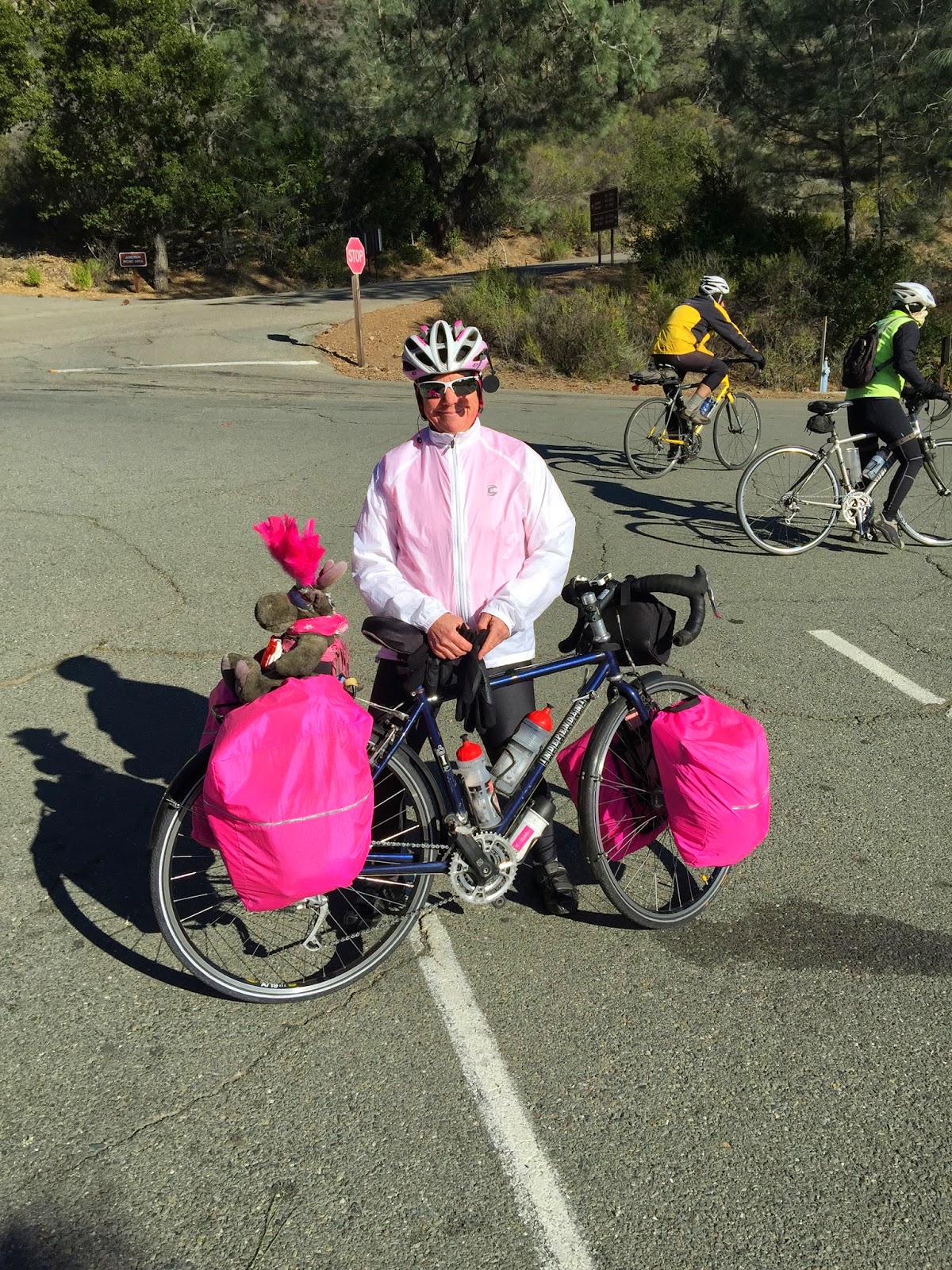
Alison at the Junction
Her windbreaker is pale pink,
and there are pink stripes on her helmet
 with me since."  If you're thinking those panniers must be stuffed with cotton candy, you'd be in for a shock if you tried, and possibly failed, to lift her bike; I'd guess it's over 100 lbs.  Alison denies any cultural significance in her pink motif, no pre- or post- feminist parable, nothing whatsoever to do with the PINK lingerie line.  She trains with heavy panniers because she and her husband love to go on exotic bike treks, and she wants to be able to leave at the spur of the moment.  She admits she stopped a couple of times on her way up, but unlike me she never walked. Like me, she turned back at the junction.


Moosie


        Oded and I agreed to try a ride into the Berkeley Hills in February, after I recover from New Years. Then he left for the summit, while I rode down to BART.  Oded's a loyal friend, and since I got laid-off in February, he's been a reliable source of quiet encouragement.  I'm starting my own bicycle commute in a couple of weeks—got a job teaching a C++ night class at a community college—and I resolved to be a better friend myself, in the uphill riding department.
A view descending North Gate
        Arguably, that's copping a plea to the indictment for today's ride, but it's also hoping to engage more with the busy world.  For example, our Labor Day ride, along the Bay shoreline from El Cerrito to Pt. Richmond, was an excursion into American industrial history. We stopped by the Rosie the Riveter museum to chat with a docent.  Rosie was the poser girl for women recruited into the war industries after Pearl Harbor, and the docent told us that the genders, and the races, got along better in the factories than they ever had before.  And quite possibly since: Ferguson burst into the headlines in the months following that ride.  Those visions of perfect wars, those shining moments of national unity—they're not the whole truth about us either, are they?
His Majesty Clark I
On the dining room table, 
waiting to be served.


         Clark was ecstatic to see me when I got home to Alameda, two short hours after leaving the junction.  I filled his food bowl, then attacked the fridge like the savage wolf I am at heart: two mugs of soup, two large carrots with hummus, a tin of sardines on a slab of bread.  It was winter, it was cold and dark outside, yet I was warm and well fed.  Happy 2015 to all.


Wednesday, October 1, 2014

Silicon Valley Brain Tumor Walk, Saturday, September 27

Laurie Graham's Calf Tattoo,
with Updates 

Laurie commissioned  the original in 2012,  to commemorate ten years since she was diagnosed with an inoperable oligodendroglioma. In the two  years since,  she's added two hash mark to commemorate survival. You can read more about her on her blog.


After the Walk,  a Survivor's Story 
Laurie said "Brain tumors are worse than most cancers because every case is unique.  For that reason it's important to form bonds.  One of the most important things that can hold us together is hope.  Every time I feel like giving up, my doctor comes up with something new for me to try.  And don't be afraid to lean on family and friends — they really want to know what they can do to help."

Honoring Team Marvin

Team Marvin, twitter hashtag #teammarvinll, won the coveted team spirit award. Here's Marvin's story, as told by his wife Valerie on the team web site: … diagnosed with a glioblastoma … on his 32nd birthday in April 2014.  He underwent a craniotomy … and finished his initial round of chemotherapy and radiation …   I am walking for him, our son, our baby girl on the way … and to raise money to help find a cure 


    The Silicon Valley Brain Tumor Walk made a strong showing in its second year, attracting over 500 walkers, and garnering over $105,000 by the time those walkers had completed the course.  Jenifer Printess, the new Director of Events for the National Brain Tumor Society (NBTS), announced the totals from the podium.  She told us the NBTS will use our contributions to develop "policies and procedures" such as "new clinical trial endpoints," which presumably would streamline the FDA-approval process for promising treatments. Jenifer also said the NBTS is participating in a "research collaborative" whose goal is to double the glioblastoma (GBM) survival rate.  GBMs are the most common, and the most lethal, form of malignant brain tumor; patients can expect to live just fourteen months after diagnosis, and there have been only incremental improvements over the past decade.

     Despite frustration over slow progress on GBM treatments, brain tumor walks are a valuable opportunity to learn about new developments.
      NovoCure had a booth.  Their device, which kills tumor cells with magnetic fields, was approved by the FDA after clinical trials showed it was just as effective as Temodar, the current "gold-standard" GBM chemotherapy — that is, it helps only about one in five patients.
      OncoSynergy had a booth too.  Their flagship drug, OS2966, provides "multiple mechanisms of action that can be used for different types of cancer and at different stages," and has shown "preclinical efficacy in multitherapy resistant brain cancer."  It is currently being prepared for phase 1 clinical trial (i.e., to test that it does no harm). 
      StemCycle did not have a booth, but two of their officers, Matt and Pete were present.  StemCycle tailors treatment plans for individual patients, including diet plans.  Matt recommends the ketogenic diet, originally developed to treat epilepsy in children, as a good way to fight cancer.  The variant he likes is 75% fat, 20% protein, and 5% carbohydrates (compare to smooth peanut butter, per CalorieLab: 78% fat, 17% protein, and 13% carbohydrates).  The concept behind it is that if a diet is low in carbohydrates, ketone bodies replace glucose as the energy source for cells — and cancer cells cannot metabolize ketone bodies. 
      Finally, I had the chance to chat with somebody who gave me their not-too-well informed impressions of a 2012 phase 1 clinical trial that tested a cannabinoid named CBD (non-intoxicating) as a GBM treatment. This person agreed to put me in touch with someone who knew more about the trial and could provide details. However, it seems important enough to justify passing along third-hand impressions now, since many people believe the anti-tumor properties of cannabinoids are only overlooked due to drug law insanity (Jean and I were certainly in that camp). Just bear in mind that I'll likely post additions and corrections.
      Third-hand impression — the outcome did not demonstrate clinical effectiveness. The researchers speculated that this was because CBD was not present in the brain in sufficient quantity, and that a shunt delivering the cannabinoid directly to the tumor site might yet provide better results.  But nothing in this test supported the notion that the CBD inhaled with marijuana smoke is a brain tumor panacea. Of course that doesn't mean cannabis is not useful and important as palliative medicine, but that's a different question.

     Brain tumor walks are also a way to draw inspiration from how other people confront a terrible disease.  Everyone has a story to tell.
      Dr. Melanie Hayden, now a neurosurgeon at Stanford, recounted her story from the podium.  Her uncle was diagnosed with a GBM when he was thirty-five, the same age she is now.  He did not beat the odds.  Afterwards, her parents took her cousins into their household, and her uncle's fate inclined her toward treating brain cancer.
      Dr. Anne-Marie Carbonell, OncoSynergy's VP of Clinical Development, was known as "that doctor with the pink lipstick” when she was a neurosurgeon. Then "I went from doctor to patient.  A few surgeries and pacemakers later, I realized I could no longer return to the career I had been working towards for the last decade."
The hashtag is #cancersucks.
The turquoise t-shirt is for Mikey's Militia
      Dr. Shawn Carbonell, OncoSynergy's CEO and Chief Scientific Officer, is also an ex-brain surgeon.  He spent "18 years prepping for a career as an academic neurosurgeon," then abruptly abandoned his clinical practice to work full time on a cancer treatment idea that "burned a hole in my brain" (no tumor reference intended).  When he met Anne-Marie, and "found out she was single and was no longer in neurosurgery I made it my mission to both marry her and hire her."
Big Al's Team
      It's a sweet story, read more by following the Science Exchange blog links (above).  The Friday night date tradition for this happy couple is to discuss clinical plans for the family business.
      And of course there are the survivors, each and every one given terrible news by a doctor, that dreaded conversation; all present this day deciding that life means more than just survival, that part of their healing is to advocate for all brain tumor patients.
      And last, there are the families and friends of those who survive, and of those who did not. Few of us would object if you say we're also the least important element in the mix, that word comes up for us so often: It's the least we could do, go on the walk.  At least we designed catchy t-shirts and cute signs.  At least we can do something to show how much we love them.
      If our loved one did not survive, and we were very lucky, we found fresh words to tell them how deeply we loved them, while we still could.  If your loved one is surviving a malignant brain tumor, you may wish to consider trying your luck now.


Friday, August 22, 2014

Wood Street Gets Serious about Canning

Gale coring apples
Sam peeling apples
Every year the orchard gave us more fruit than we could dream of eating, and just giving it away was a lot of work. Many people were generous with us too, and we particularly liked the mason jars of homemade delicacies we received from our friends John and Sue.  This past year and a half those jars have been filled with soups, exactly the warm touch I needed.  This summer, inspired by all those jars, I decided to try my own hand at canning.

Of course that's much more work than just giving fruit away; family and friend to the rescue.  My oldest sister Gale and my younger son Sam both helped me prepare applesauce, and the pictures tell the story.


Sam pausing in his work
The tools of the trade,
some of what we made
Gale was first, when the only specialized equipment I had were the jars, bands, and lids themselves.  Then I talked to my friend and colleague Ted, ever generous with his candid opinions, who politely but firmly refused when asked if he wanted to take a jar home with him.  He pointed out that "You needa huge pot with a rack" to boil the jars, that just putting them in a pasta maker simply wouldn't do.  Next week, on day one of Sam's apple peeling efforts, we both donned masks and gloves, and used the huge granite pot you see in the last photo. But some of the jars had air bubbles at the bottom and needed to be reprocessed. On day two we had the fruit spatula you see in the foreground of the same photo, used to remove remove bubbles by sliding it down the side of the jar and pushing toward the center.  We also had the tongs that the spatula rests on, used for lifting hot jars out of the granite pot.  I had been using my hand wrapped in a dishtowel; surprisingly, I avoided a serious scalding.  De Tocqueville quipped that "God protects fools, drunkards, and the United States of America," and it seems her beneficence extends to ordinary Americans and their follies as well.

This weekend Gale's coming over again, and we'll use our cumulative experience to make the last batch. Will any of these final, safest jars, find their way into holiday gift baskets, with cute labels compressing a family newsletter saga into a few square inches?  Maybe in 2015, after I past last and most important food safety test, surviving a year on my own sauce.

Wednesday, June 25, 2014

Jean Lewis Scrapbook Story Part 1

Healthy baby Jean

A Truly Happy Childhood


This is part I of Jean's "scrapbook story," presenting her life before the tumor.  My goal is to have part II posted by July 1, 2014, and I probably will.  But it's been much harder to write than part 1: many details, still some tears, many difficult subjects to try to present with the right touch.

Disclaimer: The scrapbook story is intended as a whirlwind tour, and many important people and events are omitted. Please do not be offended if you are not included, my goal was to write something just long enough to give a sense of Jean's life. And of course many of my decisions on people, photos, and events were rather arbitrary.

-- µ

Jean was born on March 28, 1956, in the college town of Ann Arbor, Michigan, to parents who both had advanced degrees. Her mom Sylvia had a Master's degree in education. Her dad, John Lewis, Ph.D., was a chemical engineer, born into a poor, violent family, who had acquired an education by dint of his intellect and his scholarly disposition. John was revered for his deft, quiet wit, and his determination to give his own children the nourishing environment he had lacked as a boy. He and Sylvia would provide their daughters the same encouragement and opportunities that they provided their son.

By nature or nurture, Jean would inherit John's wit. Not the first person you'd notice at a party, but the one you'd remember longest, whose words would reverberate in your mind.

After Jean came Anne, then Ray
John and Sylvia had lost their first child to Sudden Infant Death Syndrome, and were extremely protective of Jean. But that did not stifle her spirits. She remembers camping trips; hunting for fossils with John; climbing trees; sneaking downstairs to watch Perry Mason, a show her parents thought best reserved for adults. 

While at Greenhills JHS, Jean made a vivid impression in her math class by memorizing several hundred digits of ∏. Jean convinced her friend Linda Hutchins to try "witchcraft," and the two chums cast spells to reveal their futures. 
Louise, René, and Jean
Jean also inspired Linda to dive into knitting, ice skating, and Morse code. Linda remembers young Jean fondly for her "infectious enthusiasm," a wonderful quality she carried with her to the very end.

At Huron High, Jean played flute in the marching band, started folk dancing, and 
At Huron High
was a top student. She made friends easily did not date much. She loved to read, and took French and Latin. To support athletics for girls, she also signed up to run cross-country, but did not practice because her main interest was band. Her friend Yao Louis remembers that when it came time for the meet, only she and Jean actually ran; the other girls, who'd had time to practice, all came up with excuses. Thereafter, Yao valued Jean for her daring and resilience, her ability to turn something intimidating into something fun and interesting.


College Days: Blossoming Out


Jean was invited to apply to Ivy League schools on the strength of her grades and test scores at Huron High, but she decided to go to college in her home
A confident, prepossessing
young woman
town. She entered the University of Michigan as an engineering major in 1974, thinking that she might follow in her dad's footsteps; she did share his interest in science and nature. But engineering didn't work out for her. In high school, she was always at the top of her class, and had not needed to ask her teachers for help. In college math and science classes, she had questions for her professors, but found that she was too reserved, or too proud, to ask them. She also felt socially isolated among the young engineers, and took a leave of absence after her freshman year.

She came back as a Russian Literature major one year later, moving into the Nakamura co-op where Yao was already staying. It was a happy decision, both intellectually and socially.

Jean never lost her
capacity for joy
Sailing with Yao and her
boyfriend
The University of Michigan was a center for Russian studies, and with her love for literature and gift for languages, Jean soon found a niche in the department. She found an outlet for her love of nature through hiking trips, especially on the Appalachian trail. And she made many new friends; had serious boyfriends; and became best friends with Yao, nurturing her through a personal tragedy and helping to rekindle her enthusiasm for life.
  
Jean worked part-time, first at restaurant jobs, then as a copy editor at one of U. of M.'s renowned journals,
On the trail
Mathematical Reviews. That work suited her well, weaving together the two major strands of her intellectual interests, science and language. She graduated from U. of M. with a BA in Russian Literature in 1984, and embarked on a career as a technical editor.


Jean Lewis, Technical Editor


The Jester at a URS Halloween party
Jean's career took off after she came to California in 1988 and moved into the engineer consulting world at URS. Not everything in that world was ideal: for example crazy hours, impossible deadlines, and insatiably demanding managers.  But she loved her colleagues, and thought of them as "smart people, making funny jokes all the time and talking about their new interests." 

What Jean did also had an intrinsic value. She worked on large, visible engineering projects, such as changes to airports and bridges, and the documents she edited were critical to describing those projects to technical and lay audiences. Renowned for being able to zero in on the sole typo in a crowded page, able to read the twentieth iteration of a technical document with the same fresh attention she bestowed on the first, Jean earned a niche of respect and accommodation in the corporate work
Part of the world's greatest get well card,
from Jean's URS colleagues after her brain tumor
surgery in 2011. The limerick by Pam Cory in the
upper left (There once was a lass from Ann Arbor…),
captures much of Jean in five breezy lines.
place. At the center of the process that creates the documents that guide the projects that shape the Bay Area, said niche was a better perch than many for looking out on the bustling world.

Her colleagues esteemed her highly. Deme, with an, international reputation as a soil
A visit from engineering colleagues while at the hospice:
Deme on left, Maria and Susie on right
scientist, insisted on having Jean edit his reports. They came in a steady stream when she was at the hospice, paying tribute, sitting by the bed, talking about old times, and just holding her hand when she could no longer talk. The last gesture she made to a visitor was a high-five with Deme, acknowledging the painstaking, important, and satisfying work they had accomplished together.


Mid-Life Romance


March 21, 1998
We were married in 1998 on the first day of spring. We had met folk dancing, had a passionate romance, and we were still trying romantic kisses when Jean was in the hospice.

One of our staple jokes was that we were really the same person: we both disdained conflict; had niches in the technical world; thought of ourselves as quiet, bookish, offbeat. But we came to this common ground by very different routes.

Before me, Jean had two long-term relationships that didn't quite work out, and I'd had a disastrous first marriage. My dad Charlie Pico was a street artist/carny; he made sure he would be the first person anybody would notice at a party, and would likely have the gathering laughing uproariously. He died in 1990, three years before John, but the dads might not have known what to make of each other had they lived to come to our wedding.

Languorously happy on our honeymoon
But we did not waste time comparing John and Charlie, or dissecting past relationships. We were too busy. We moved in together the day after the wedding, one week before leaving on a month-long honeymoon in Israel; we were so tired that for two days after we got there, that we fell asleep wherever we went. After we recovered, and then for much of the next three years, we devoted ourselves to racing the biological clock, trying to have children of our own. But the best we could do by our own efforts was one miscarriage. Two years of fertility treatment resulted in two more miscarriages with implanted embryos. But we found other ways to have fun.

For example, by crossing that threshold of middle-class respectability, home
The Happy Couple by Tom Kennedy,
an artist who often worked with my dad
ownership.  Jean, an avid gardener, wanted a blank canvass: a large, ugly backyard she could transform with her creations. The Victorian cottage we found on Wood St was charming, but the backyard was too small to hold even the fifty potted roses we brought with us. Then we bought an overgrown parcel in back of the cottage, called “the orchard” in the neighborhood. Jean had her dream house.


Moments from a Marriage


Jean was a volunteer research editor for a magazine called Rosamundi, devoted to preserving old and wild roses. In 2014, they published a special edition called Wild and Untamed, including an essay by Jean called My Healing Garden, describing how 
May 2010, Portrait of the gardener in a 
gentle hurry, a bit of her effulgent front 
yard garden creation in the background
she tended her preservation rose gardens in the orchard after she was diagnosed with a brain tumor. Next to her by-line is a photo (shown on right) taken as she was dashing off to a Rosamundi meeting, bouquet in her backpack, coffee mug in hand. It was such a devastatingly characteristic moment I'd asked her to pause -- not pose -- and be captured for posterity.

The roses in a preservation garden are endangered, and growing one successfully puts it one step further from the threat of extinction. In gardening, Jean found a way to create beauty, while doing her bit to save the planet at the same time.  She was very good at finding creative solutions to problems with real-world constraints, like limited time.

Other moments glowing in loving memory: the way she read and wrote in bed, to the delight of our cats, who would try to curl up on her keyboard…bringing blog post drafts into the bedroom for her to edit, getting them back with a smile
We enjoyed
ourselves
that made the red ink feel like
In the orchard
kindness; then repeat, as the red ink dwindled and disappeared…the way she would leap out of bed and get ready for her day, so quietly I wouldn't hear her, then appear before me saying "I was just planning what I was going to wear"…the time we were Darwin's Primeval Soup (me, Earth as soup can) and Emergent Life (she, evolving life forms) for a Halloween party…giving lessons at our garden parties on making Ukrainian Easter eggs (pysanky) -- dip the eggs in a series of dyes going from lighter to darker, each time adding more wax to mask of the area you don't want colored…giving away our last twenties, before we left on vacation, to a stranger who told her a hard 
With Felix and Zola
luck story…in a supermarket parking lot, returning our shopping cart by riding it like a scooter; not showing off, just the joy of the girl bubbling up in the life of the woman.


A dozen + 1 of her Ukrainian Easter eggs


Wednesday, June 4, 2014

Next stop first grade


Nate gives approval
for the ceremony to start
Before ceremony close-up, with
friend mugging for the camera

On Monday, my youngest grandson Nate Kurtz graduated from kindergarten at Riverside elementary school, in Richmond CA.  Nate has accomplished much in the past year.  By March, he could write the numbers up to 30, knew 16 out of 30 of his "sight words," and was learning not to play so rough with his peers.  He is ready for the first grade.

The Riverside student body is about 3/4 Hispanic.  Mr. Garcia, the principal, spoke first in English, then translated his remarks into Spanish himself.  Mrs. Maldin, Nate's kindergarten teacher, spoke in English, then another kindergarten teacher gave the Spanish version.  The Riverside neighborhood is not exactly a trendy part of the Bay Area, and there are fewer white children than either blacks or Asians in Nate's class. But if you are adding up these factors and guessing that Riverside has inner-city school problems, take a closer look.

Riverside has a strong anti-bullying program, not just in words, but in serious consequences for students caught fighting.  Other Bay Area elementary schools actually have drug problems, but Riverside does not.  Their report cards grade students on many specific categories.  For example, Nate was graded on "Identifies and produces rhyming word in response to oral prompt" and "Blends sounds in one syllable words."

Dollar bill origami were
popular garlands
The graduation ceremony showcased the results of this approach.  Mrs. Maldin told us that all graduates needed to be ready to start reading, and that counting to thirty was the standard new first graders were expected to meet.  Then she had had the graduates count to a hundred, in unison, first by twenties, then by tens, fives, and twos.  Then the graduates recited the months of the year, then the days of the week.
Nate hands Tamar a red carnation


Riverside honors the magnitude of the graduates' achievement by making a big deal of the ceremony. That means honoring parents too.  All the children filed in holding red carnations, and Mr. Garcia closed his remarks by asking each child to give their carnation to their parents (or significant parental figure).  Many families made special garlands for their graduates, or gave them balloons, so they could carry the family standard with verve and style. Nate's big brother Moises was an usher, passing out programs, and his big sister Sarah was there too, dressed to the nines.

Mrs. Maldin's daughter, who recently received her Bachelor's degree from St. Mary's college in Moraga, gave the commencement address.  She read the graduates one of her favorite Dr. Seuss passages, from Oh the Places You'll Go:

  You have brains in your head. 
  You have feet in your shoes. 
  You can steer yourself any direction you choose. 
  You're on your own. 
  And you know what you know. 
  And YOU are the one who'll decide where to go...


Nate at the graduation banquet
Nate, Tamar, and friend at the banquet


She advised the graduates that as they press on in life, deciding on direction and and destinations, their goal should not be to see how many friends they can make.  Instead, they should try to see how many good friends they could keep, the good friends being those who believed they could make their dreams happen, despite the naysayers.

After the ceremony, the party moved to Nate's kindergarten classroom, where we enjoyed a potluck banquet.  Nate is a picky eater, but he gave the fried chicken and watermelon enough attention to get down a few bites.  I enjoyed the macaroni and cheese and pasta salad immensely.

And after the delicious potluck banquet, Nate and his entourage went to his great-grandmother Margaret's house, and Nate, siblings, and friends plunged into the joys of summer vacation -- hooray!  The first thing Nate wanted to do was to draw some pictures for grandpa, and he had me go out of the room so I would be surprised to see what he had made.  When I came back, he presented me with my very own picture of Sponge Bob, as if somehow he'd known that was exactly what my refrigerator door needed.  In case you're wondering, the blue checkmark to the right of Nate's name is what Mrs. Maldin would have made, if she thought the picture was complete. 

"Sponge Bob," by Nathan Kurtz,
for grandpa
Picture of the artist
displaying his palette.