Sunday, May 4, 2014

Bay Area Brain Tumor Walk, Saturday May 3, 2014


Jean Lewis at the Page-Laguna Park,
next to the Zen Hospice,
December 24, 2012
1,644 participants came out for the Bay Area Brain Tumor Walk in Hellman Hollow in San Francisco's Golden Gate Park yesterday, donating over $391,000 to the cause, according to preliminary totals announced by the emcee, Renne Richardson.  80% of the donations collected by the National Brain Tumor Society (NBTS) go toward finding cures. Renee, the host of the KFOG morning show, introduced Brett Johnson Ph.D., a brain tumor researcher from the University of California at San Francisco (UCSF), who told us how NBTS funding facilitated his work.

Dr. Johnson explained that NBTS funding "kick starts" his research, which gets government funding if the preliminary results are promising. He described one current clinical trial, a study of a cohort of low-grade glioma patients who received multiple surgeries, followed by chemotherapy with temozolomide.  The study's goal is to find out how temozolomide impacts the mutation of gliomas, using next generation DNA sequencing (NGS) to profile tumor cells.  If you're unfamiliar with the medical terms, cohort is like classmates; gliomas are tumors of the connective tissue of the brain -- and if you must be diagnosed with a glioma, a low-grade is the grade you want; NGS is the term for technologies that accelerate finding nucleotide sequences in a DNA molecule; and temozolomide, better known by its brand name, Temodar, was the "gold standard" chemotherapy for treating glioblastomas (GBMs) in 2011, when Jean was diagnosed.  (It was approved by the FDA in 2005, based on increasing the average survival time for GBM patients from 12.1 months to 14.6 months.)

GBMs are the highest grade of glioma, and the most common and most deadly type of malignant brain tumor.  The NBTS also has an overall goal of doubling the five-year survival rate. As a point of reference, statistics accumulated by neuro-oncology researchers at UCLA show a five-year GBM survival rate of approximately 18%.
   
In addition to Dr. Johnson, UCSF was represented by a fund raising team, including at least one nurse who worked with Jean.  Stanford oncology had a team too, as did Lumosity, a software company producing games that train memory and improve cognitive skills: Jean used their products to tell if the tumor was progressing, with the hope that staying sharp would keep it at bay.  Many teams had names with themes inspired by conquering cancer, such as Team Toast (as in, this tumor is toast), and the Tumor Tamers.  Oligo Nation, which raised several thousand dollars, was started by parents of two children diagnosed with oligodendrogliomas.  The etiology is unknown, and both children are now young adults.  Some team names were just festive, such as the Jolly Rogers, who came in full pirate regalia, and distributed disks the size and shape of silver dollars, heads a grinning skull, tails an open treasure chest.  The Jolly Rogers are named after Roger, a long-term brain tumor survivor, who walked The Walk every year for 10 years. After his death, his widow Dawn formed the team to carry on his fund raising efforts.

The Tatsumaki Taiko drummers provided rousing, festive entertainment after the walkers returned from their trek.  There were two rows of them on the stage, three in back with smaller drums, laying down background rhythms; and three in front on large, two-sided drums, coming in to the performance one at a time, building the intensity as each entered, whirling and gesturing between synchronized drum beats.  Watching, hearing, and feeling their performance, it was easy to imagine burgeoning life force gathering its strength to vanquish tumor cells.

This year I participated as a volunteer instead of a walker, and Oded Angel, a colleague from my Bank of America days, worked along with me.  Oded has been a close family friend for many years, planting a tree in our little orchard after Jean was diagnosed; visiting Jean when she was at the Zen hospice; and remaining loyal and supportive to co-workers, like me, who were sacked in the big layoffs this February.  He has a thing for good causes, and last week he roped me into helping out at the National Multiple Sclerosis Society's Lake Merritt walk.  The problem with befriending such noble souls is that when they say vexing things like "let's go to the brain tumor walk by BART and bicycle," you can't really say no -- even if it requires a little lifestyle shift for a sedentary sixty-three year old.
Oded Angel, at Hellman Hollow
after the Brain Tumor Walk

Truthfully, since Jean passed last year, I haven't ridden anything but a stationary bike, and have even fallen into the slothful habit of driving my car to do short errands. Oded and I met up at the MacArthur BART station at 7:15 am, and then the ride to Hellman Hollow took about a half hour.  I only felt geriatric twice during that journey: carrying my bike up five flights of stairs to street level at the Civic Center BART station; and climbing the big hill going west on Fulton toward the Golden Gate Park panhandle. But let it be recorded, I made it to the top both times without stopping, if not without panting.

When the walking and the speeches and the drumming were over, we stacked and folded chairs and tables, unlocked our bikes, and rode back.  We took Page street east from the panhandle, and stopped when we got to the Zen Hospice, 273 Page Street, corner of Laguna, a couple blocks above Market.  Oded said we were very lucky to find the place.  People always say that.  I said we made the best of a terrible situation, and that in an odd way, that time together at Jean's death bed, saying things we needed to say, was the vacation together we'd needed for a long time.  I always respond like that.  Oded murmured something non-committal, and we changed the topic.  That always happens.

We rolled our bikes into the Page-Laguna Pocket Park, a little gem next to the hospice.  Jean and I came there on two occasions, and Oded heard, not for the first time, the story of one of those visits. We'd stopped by after lattés at the Samovar Café, where Jean, that legendary, uncannily accurate editor, had found several typos in the will prepared by our attorney.  This was near the last stage of her struggle with her tumor, when she could no longer stand up unassisted, and was dismayed to learn she could no longer play the flute. I remember how much she liked the canna lilies.
Pathway at Page-Laguna Park,
Matt Pico's collapsible bike 

They were beautiful yesterday too.  As was the fig tree, and the many flowers whose names Jean would have known, but I don't.  Riding our bikes had been a great idea.  Jean, avid gardener as well as editor, would have approved of us doing our bit to save the planet.  As she would have recommended the Zen Hospice to anyone who values compassionate staff, even to those, like me, whose skepticism clashes with Zen spirituality.  And one year later, I would recommend it too.  Even if the NBTS succeeds in doubling the five-year survival rate -- an ambitious, historic goal -- the vast majority of people with GBMs will not make it that long.  If a brain tumor is poised to take your life, and medical science offers nothing that has already been approved by the FDA, I salute those who refuse to give up, and keep looking at clinical trials; and understand those, like us, who decide instead to look for a quiet, comfortable place to say goodbye.


Page-Langua canna lilies, 2014

Monday, March 31, 2014

All Rivers Return to the Ocean -- the Zen Hospice Evening of Remembrance


We sat in backless chairs in what was called the big room when Jean stayed there, a living/dining area that was large enough to seat dozens at the 2012 holiday banquet. We faced an altar that held two ceramic bowls, one filled with petals, the other with water. In front of the altar, on the floor, was a wide, cylindrical, clear glass vase, nearly as tall as the altar.  In back of the altar was a gong with a striker.

The hospice volunteer coordinator began the ceremony by asking us to consider, hold in our hearts, the possibility that this ceremony might be the very last time some of the names we were going to hear would ever be spoken aloud: some of us die alone, with no intimates to hold us in loving memory.  Then the hospice staff took turns coming up to the altar, each reading a handful of names from a list of sixty-two of the departed.  After they read, they took petals from one bowl, sprinkled them on the water in the other, and tolled the gong.

When all the names had been spoken, they read The Thing Is, a poem by Ellen Bass.  If Ellen's right, and the thing is to emerge from grief and to love life again, some will need to raise our sights.  When Jean was at the hospice, a good friend told us she had accomplished something truly major in the year after she lost her partner to a brain tumor: she had survived.  Now I understand. Perhaps embracing life comes in year two.


After hearing from a celebrated poet, the mourners had their say.  We passed a small "talking" object along the rows of chairs: holding it in your hand gave permission to speak your remembrance.  One said his loved one's dying was a "great experience" -- yes, he used that very phrase -- while another, searching for words that reflected the glow, offered "death with community."  One of the hospice staff said it was a privilege, a great honor, for families to allow them in "behind the curtain," to help them during their most difficult time.  Whether you're at home or in the hospice, family life is what it is: one woman, who lost her father at the hospice, got a laugh by thanking the staff for putting up with her mom, when "she was so annoying."

One of the night attendants -- at the Zen Hospice, staff can also be mourners -- recalled Jean through tears: how unable to stand without assistance, she'd quipped "let's dance" when they helped her out of bed; the pleasure Jean took in having her hair dyed a startling shade of blue-black, in getting a manicure.  I used my time to say Jean would have appreciated the significance of the last time names would be spoken: she had a way of remembering the forgotten, making the ordinary seem special.

They closed the ceremony with another ritual, tossing a handful of salt into the tall, clear vase, and leaving us with the thought that "All rivers return to the ocean at some point.". Whether we have intimates or not, all of us are destined to be forgotten, as the people we knew die themselves, as the ripples made by our lives fade away. If we want any resonance from our lives to continue, it can only be as part of something larger than ourselves.  Opinions about that something vary greatly.

After the ceremony, the refreshments.  We migrated from the big room toward the kitchen, after being admonished to be mindful of the residents and their families upstairs.  Food is always a high point at the Zen Hospice. The kitchen staff is excellent, and the mood is impatient with abstinence: might as well enjoy what you can, when you're living under the shadow of death. This time, the vegan chocolate chip cookies and the apple slices infused with spices were especially noteworthy.  We crowded around a table piled with such savory delights, saying the hellos and goodbyes that would need to last until 2015.  

Before the ceremony, one of the staff had told me it could be a tad disorienting to see people he knew from the hospice, on the outside.  There was often a moment of confusion, and then after the recognition -- oh yeah, that's where I know you from -- came the question of how those two pieces of a life could possibly fit together.

I may know what he meant. Zen Hospice is so special, so small, a place like no other, where you can be initiated into the mysteries of compassion.  And the big, bad world?  It can be demanding, threatening, can it not, with firm boundaries essential?  And every so often, it does afford exhilarating adventures.

Walking toward the hospice on the way to the remembrance ceremony, the hospice reality inside me growing stronger, I could not help but measure my life across the year that had passed since Jean did.  A bit like the approach of Yom Kippur for Jews, or a Catholic en route to confession.  Was I really more compassionate?

Maybe.  I'd helped my younger son get into a drug rehab program, and now we're hanging out together on weekends, working on my house, laughing and talking more than we ever did.  But boundaries are important there too: family life is what it is. There be times when you need to call on whatever resources you have, from wherever, breathe deeply, and say what you need to say. Watching someone die, someone you really love, is terrible -- I would never call it a "great experience."  But you can draw strength from that memory. You stayed to the end.  Now, afterwards, keep going.

Friday, February 21, 2014

Need photo or drawing of Mickey Pico's bagel stand in Juneau

If you have a drawing or photo of Mickey's bagel stand that could make a suitable image for his tombstone, please send it to me at 1853wsvm@gmail.com.  Mickey's time as a food vendor was one of  the high points of his life,  and might be good to include on his permanent memorial.  According to Jewish tradition, nothing on the grave marker should represent a human form, but I think just the structure would be OK. 

Wednesday, February 19, 2014

One year after

Commemorative Cake from Feel Good, Jean's favorite Bakery

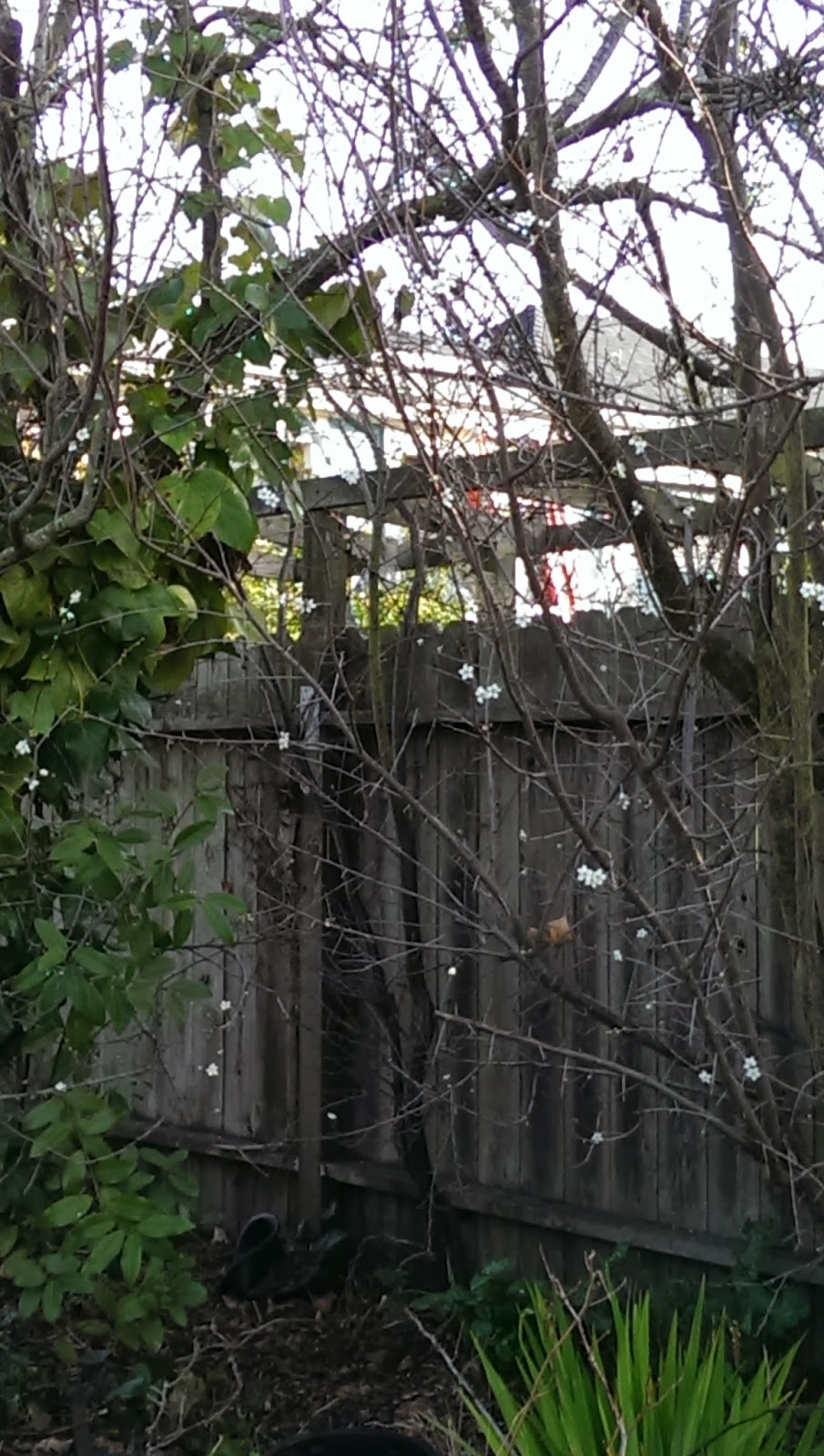
Jean left a year ago, but she has not been forgotten. Sunday we gathered in the backyard at Wood Street, sharing memories, and appreciating the stirrings of spring as she would have: the plum tree overhanging the potting table already sports a few of its five-petaled white blossoms.  And we
Blossoming tree, which will bear
little yellow plums in early summer
talked about her grave marker.  Our memories of Jean, condensed to a few bare phrases, must soon be set in stone.


The surviving spouse designs the gravestone, and according to Jewish tradition I had a year.  Time's up.  Could not do it, did not want things finalized, the necessary phrases eluded me. There was a little room for manoeuvre: Jean was a Unitarian, so the tradition does not fully apply; and Oakmont was prepared to be patient, up to a point.  They'll reach that point Friday, February 28, when I go in to show them a design.

Part of the job will be easy.  "Jean Mary Lewis" on one side, with "1956 - 2013" underneath; "Matt Pico" on the other, over "1950 - ".  Somewhere on Jean's side, an acknowledgement of the esteem of her colleagues, "Talented Editor."  Also her major personal roles, "Wife, Daughter, Sister, Friend."  And as space allows, emblems of a few of the things she loved intensely: a cat, a rose, musical notes, a stack of books.
  
One minor problem is that "Talented Editor" does not quite do the trick. If you have a better phrase that captures her career, do tell, I'm open to suggestion.  But something big is
Clockwise from left: Vivien, Tom, Lulu, and Pearl
engrossed in a book on making silly sock creatures
lacking, a reach for words that tie the roles, the career, and the emblems together, that say how wonderful it felt to be in a world with her in it.  I was stymied, looked through the talks given at her memorial for inspiration, and came across this from Derek McCulloch, her manager at URS:


"...She improved every document she read...She would take plants that wouldn’t grow, and make them thrive.  She’d take in lost and sick animals, and care for them, and as much as possible she’d make them well. If her friends were in difficulty, she would try, however she could, to help make things better..."

He could have added "husband" to the list of improved entities.  I was a bit like a domesticated feral who, contrary to previous experience, discovered he thrived in married life.  "Thrive," that word stuck with me, so I tried using it on the cake.  What do you think?  Again, tell me if you think you have something better before 28th.


Clockwise: Tom, Lulu, Pearl, Melba, Scott, Charlie, and Bob
One final design note.  Bob Bulwa, ever creative, suggested an image of dancing flutes, one resembling Jean, the other me.  Not sure if that would work; for one thing, only Jean was a flautist.  Perhaps a Pied Piper motif?


For the backyard crowd Sunday, life went on, and there are important successes to report. Our good friend Nick Galloro, who we turned to for help in our darkest times, is now in a relationship
Clockwise from bottom:Oded, Pearl,
John, Melba,  Sue, Charlie
with an attractive, personable woman by the name of Ronnie: so far, so good.  John Gregorin and Sue Torngren continue as great resources for gardening help and advice; they spent part of their time Sunday grafting apricot scions onto our plum tree (see photo).  Our friend and neighbor Tom Borchelt recovered nicely from knee
Apricot scions on our plum tree
(thanks John and Sue)
surgery.  Derek and Tara's daughter Pearl is no slouch at "making things better" herself; this last holiday season marks year II for "Cards from Kids Who Care," an activity to help the homeless she conceived, with help from her parents, after an encounter with a street person on her way from a performance of Dickens' Christmas Carol.


Others of us have faced challenging times, as the economy sputtered along, and loyal corporate citizens were rewarded with layoffs and reduced hours; and then there are those of us, such as my younger son Sam Kurtz-Pico, who have never even tasted the good life of health plans and 401Ks.  If you'll forgive me for ending with a shameless plug, Sam is making important changes in his life,
Clockwise from bottom: Oded, Vivien,
Derek, Tara, Pearl
after having a very rough time of it in 2013: one additional change he'd like to make is to find a paying gig, any time after 3 pm on weekdays, and at any time at all on weekends.  Sam is highly intelligent, with a bachelor's degree in Political Science from UC Santa Cruz, and has computer
Sam Kurtz-Pico, job seeker
skills; ideally, he would like to find work that draws on these strengths.  He is also an extremely personable lad, with experience as a political canvasser and camp counselor; so a job involving sales or customer contact would play to his strong suit. But he is not particular, and is open to offers for dishwasher, janitor, you name it.


And of course there were flowers:
Bouquets courtesy of John Gergorin
and Sue Torngren

Monday, February 10, 2014

A visit from the Zehners

Chuck and Kathy at Speisekammer in Alameda, January 9, 2014
Next Monday marks a year without Jean, and my proudest achievement is just to be able to write something, anything to the blog, to have survived.  Truthfully, I'm not sure that would have happened without devoted, helpful friends, who remained loyal to a morose widower, not always an outstanding performer in the appreciation department.

There are too many of these kind souls to list here, and it would doubtless be embarrassing for some of them.  But two of the latest to lift my spirits were Chuck and Kathy Zehner, whom Jean met on the Prairie Home Companion Norway Cruise with her mom Sylvia in 2007.  Chuck and Kathy live in Illinois, and always looked us up on their frequent trips to the Bay Area to visit their son.  They came by the hospice a year ago, and Chuck serenaded Jean on his guitar, at a time when
Chuck and Kathy at La Luna in Concord,
January 23, 2014. Note the change in Chuck's grooming:
something in the Bay Area ambience inspired him
to clean up his act  
she responded to touch and music more than words.  They told me at the memorial that our friendship would endure, and it was heartwarming to see them in January, and know that was true.


Saturday, November 30, 2013

honey I'm home

A winter's tale, could be the first in a series.  For context, see Time Management for the Bereaved Computer Programmer

       "Honey, I'm Home"

    Some big decisions 
are made in moments, one per day for months.  
    Here it comes again. 
Walk through the door into a darkened, silent place, 
    where she will never be again?  
Or veer away, a stone skipped off a pond?
    He'd hated it before,
in the house alone, even for a week.
    She knew this,
worried more for him as she grew weaker. 
    Typical Jean. 
She stopped worrying, and everything else, 
    eight months ago.  
Plus three weeks.  Plus one day.

    He does enter, 
notices a bookcase photo glowing, nods.
    She's with Anne
at a hospice courtyard picnic, last time ever out of bed.
    Her face, bloated by steroids; 
Her eyes, hollowed by tumor.  He’s puzzled. 
    What luminous about that? 
He flips through the deck of her virtues: 
    gentle, intelligent, 
stops at courageous.  That's the one.  She knew
    what waited for her.
She's looking directly at it.  

    Inspired, he tightropes 
to the kitchen, faces the fridge where
    she's pinned by magnets;
backpacking in college days;
    hair short after radiation,
staring down the camera; in Hawaii,
    smiling, confident,
two months before the tumor came back.

    Crouched by his food bowl, 
Clark meets his eyes, and for another glowing moment
    he thinks the cat wants to talk,
is concerned for his mental health.  
    Those fears are groundless. 
He fills Clark's bowl, opens the fridge, scans the shelves 
    for what won't need cooking. 
He wants to make it through the winter 
    without turning on the heat.  
No big deal, Alameda seldom freezes; 
    late January, 
the first blossoms appear.

Time Management for the Bereaved Computer Programmer

After a summer writing mostly letters to Jean, I started a grief writing group in October.  As the name suggests, it combines a writing workshop with group counseling, with differences from each. Unlike writing workshops, this group values writing as it facilitates the grieving process; the point is to explore emotions, not to prepare for publication.  And unlike other counseling groups, this one has a strangely anonymous feel; some of the questions you typically have about people are impolite to ask.  For example, based on the quality of the writing -- can't help but notice -- I suspect not all of us are amateurs. But profession would be an awkward topic to raise, it crosses the boundary of knowing each other chiefly as people coming to terms with loss(es).  I'm not objecting; there is a stimulating, leveling something about being forced to relate to fellow humans on the basis of a terrible, not-quite-inevitable commonality.

Every week we get writing suggestions, such as "describe or imagine your beloved's final hours," along with examples of poems showing how much can be done with that approach.  Notable among these examples are excerpts from Without by Donald Hall, a collection of poems clustered around Hall's experience of losing his wife Jane Kenyon to leukemia.  Without consists of twenty-one short-line free-verse poems, twenty of which tell the story in chronological order.  The exception, Her Long Illness, winds around the first seven poems until arriving at the end of that illness, and the poem that lends its title to the book.  In addition to being much longer than any of the others, Her Long Illness looks different on the page because the lines are grouped into couplets of a short line of about three stresses, then a long line of around five. Hall has a preference for end-stop lines, and at times I suspect an iambic intent.

Hall's tone is conversational, direct, unaffected; like it, reminds me of Jean.  It's possible to read distractedly past one of his beautiful images, then wonder about the power of simple language after something tugs at your eye and says backup.  As in the last stanza of Letter in Autumn, about visiting Jane's grave:
... 

  Looking south
    from your stone, I gaze at the file
    of eight enormous sugar maples
    that rage and flare in dark noon,
    the air grainy with mist
    like the rain of Seattle's winter.
    The trees go on burning 
    without ravage of loss or disorder.
    I wish you were that birch
    rising from the clump behind you,
    and I the grey oak alongside.

    -- from Without by Donald Hall

But in my opinion, the most powerful lines belong to Her Long Illness.  In this excerpt, after Jane's hematologist told them "I have terrible news," they're working together on selecting poems for a collection, and on writing an obituary:

    ...he saw how weak she felt
and said maybe not now; tomorrow?
    Jane shook her head: "Now," she said.
"We have to finish it now."
    Later, as she slid exhausted into sleep,
she said "Wasn't that fun?
    to work together?  Wasn't that fun?"

    -- from Without by Donald Hall

Another Jean reminder.  Some of the sweetest marital moments of the technical editor and the computer programmer were when they worked together on their writing, and it was indeed fun, and they kept at it even after Jean entered Zen Hospice. Kept going until nearing the end of the sequence described in this stanza a few pages later:

One by one they came,
    the oldest and dearest, to say goodbye
to this friend of the heart.
    At first she said their names, wept and touched;
then she smiled; then
    turned one mouth-corner up.  On the last day
she stared silent goodbyes
    with her hands curled and her eyes stuck open.

    -- from Without by Donald Hall

This could sound unbearably familiar, if you've ever been inducted into the hospice club.  And if you questioned our group's use of writing as therapy, imagine you were Hall, and somebody in your writing group compliment you on how the quiet images in these lines built to a wrenching crescendo.  Which of course they do, and you’d revised and revised to make it so.  But she's still gone, and part of you died with her; you might not be in the mood for praise.

As for me, most weeks I've struggled to tell what it was like to be married to Jean, and to avoid talking about what it's like now.  Part II of that formula gets no prize for emotional authenticity; perhaps writing poems in the manner of _Her Long Illness_ would help me look in both directions?  Worst case, the format is possible to imitate/fake within a week; and if the writing doesn't work either as poetry or therapy, the plot is simple, so the reader can quickly move.

There's only poem remotely blog-ready at Thanksgiving time 2013, but more could come, and Time Management for the Bereaved Computer Programmer seems a clever working title for a series. Too clever? But grief does focus you on time: wishing it could run backwards; wondering if it really heals wounds and whether, in all truth, you want to be healed.  If you look at the Without table of contents with the male penchant for keeping score, you can count three titles that name seasons, three others that name holidays, one that names a specific date, and two an indeterminate time span (Last Days and Her Long Illness). Do nine time-related titles out of twenty-one constitute a significant trend?  If not, and mixing poetry with time management is just silly, at least daydreams of a poetry collection provides an opportunity to promote Hall's book.